
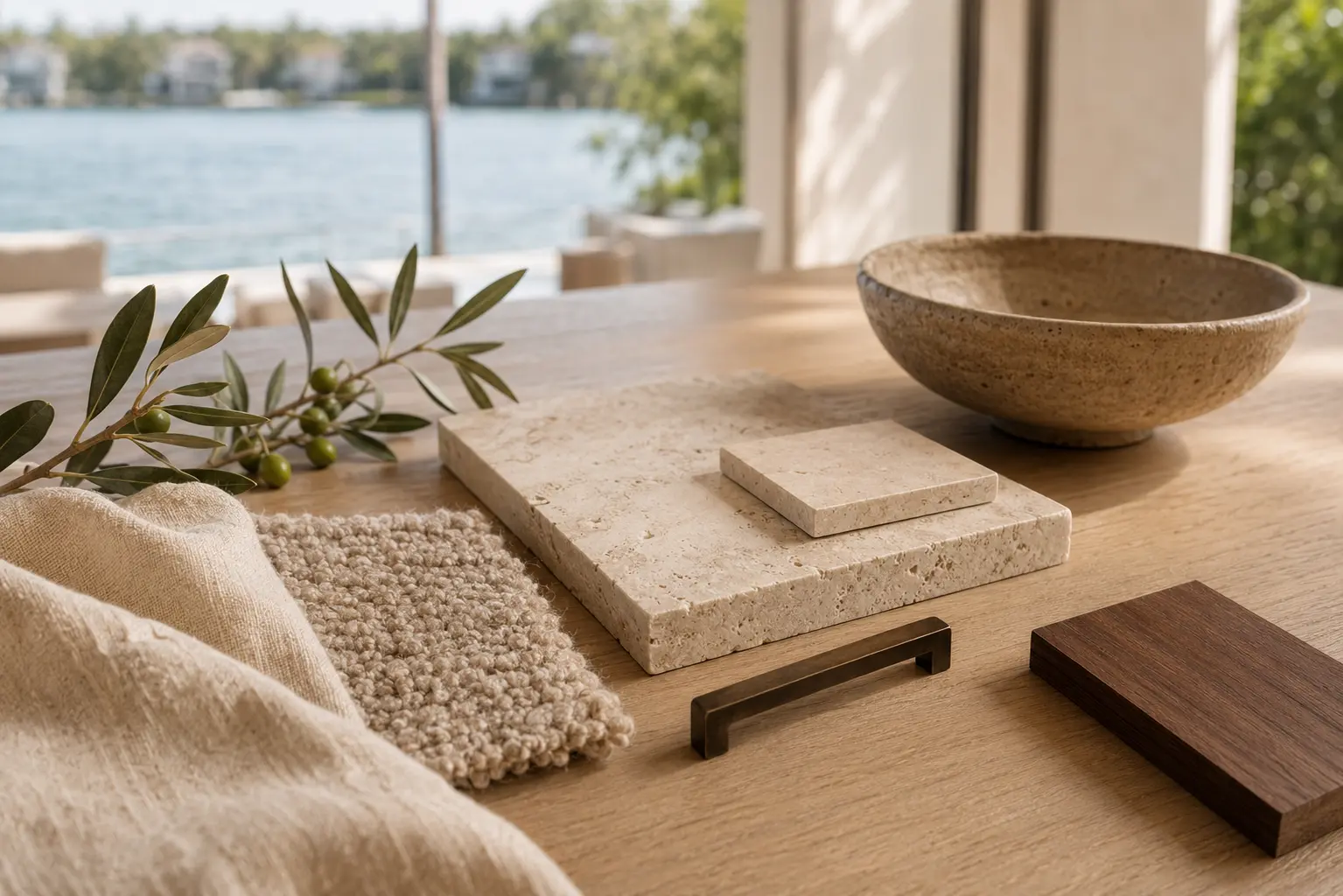
Choose natural stone for the way it will age, not for the hope that it will never change.
The names are familiar; the materials are not interchangeable
Marble and quartzite are both natural stones, but they are formed differently and behave differently. Marble begins as limestone transformed by heat and pressure. It is prized for depth, veining and a softness that can make even a large surface feel luminous. Quartzite begins as sandstone and becomes an exceptionally hard metamorphic stone. It can offer crystalline movement, saturated color and patterns that resemble marble while performing differently.
The complication is the marketplace. Commercial stone names are not always geological descriptions. A slab sold as a quartzite may be a softer marble, a dolomitic stone or another material entirely. Color and name cannot confirm performance. For BN2, selection begins at the slab yard and continues through testing, templating and fabrication.
What Florida conditions actually change
Humidity does not automatically disqualify either stone, but Florida living changes how surfaces are used. Kitchens often open to terraces and pools. Sand, sunscreen, citrus and frequent entertaining add abrasion and spills. Strong sunlight can expose every polish variation and reflection. In bathrooms, ventilation, standing water and cleaning products matter more than the climate label alone.
The response is not to search for an indestructible natural stone. It is to pair material with location. A polished marble vanity in a quiet powder room has a different risk profile from a honed marble island where children eat breakfast. A dense quartzite can be a strong kitchen choice, but only when the actual slab is understood and the fabricator knows how to work it.
Etching, staining and patina are different things
Etching is a chemical reaction that dulls a calcium-rich surface. Lemon, vinegar, wine and some cleaners can etch marble even when it has been sealed. A stain is absorbed discoloration. Sealer can slow absorption, but it does not make stone immune. Scratches and chips are physical damage. These distinctions matter because the prevention and repair strategies differ.
A honed finish can make etching less conspicuous than a mirror polish, while a busier stone can visually absorb minor marks. Some clients enjoy the soft patina that develops on marble counters; others experience every change as damage. Neither preference is wrong. The material must match the client’s tolerance, not an abstract idea of luxury.
| Consideration | Marble | Quartzite |
|---|---|---|
| Visual character | Often softer movement with luminous depth | Often crystalline, dramatic and highly varied |
| Acid reaction | Can etch from citrus, wine and cleaners | True quartzite is generally more acid resistant |
| Scratch resistance | Softer and more readily marked | Generally harder, though performance varies |
| Porosity | Varies; sealing is commonly recommended | Varies; some slabs absorb more than expected |
| Best decision tool | View full slabs and accept patina | Verify the stone, test samples and vet fabrication |
Why quartzite still requires due diligence
True quartzite is generally hard and resistant to acid, but that does not mean every slab is maintenance-free. Porosity varies. Micro-fissures may require resin treatment. Certain light stones can absorb oils or moisture at edges. Very hard material also demands experienced cutting, correct tooling and careful transport.
Ask the supplier for the geological classification and recommended care. Request a sample from the selected slab when possible, then test water, oil and lemon in an inconspicuous way with professional guidance. The objective is not laboratory perfection. It is to discover whether the behavior supports the intended use before fabrication makes the decision irreversible.
The design decision goes beyond durability
Marble often brings quiet depth to bathrooms, fireplace surrounds and architectural walls. Its visual softness pairs beautifully with plaster, warm wood and aged metal. Quartzite can carry a stronger crystalline presence and works well when an island or vanity is meant to act as a focal object. The same stone can feel calm or theatrical depending on cut, vein direction, edge profile and the number of seams.
BN2 studies the entire slab, not a small sample. We identify the most expressive areas, locate unavoidable fissures, consider book-matching and draw seam positions in relation to cabinetry and fixtures. Material selection and space planning belong together: a beautiful slab loses its power when a faucet, outlet or seam interrupts the wrong moment.
Thickness, edges and fabrication
A delicate edge can make a substantial island appear tailored; an overbuilt miter can make it feel heavy. Waterfall ends showcase veining but require excellent vein alignment. Integrated stone sinks are sculptural yet demand careful detailing and realistic expectations around joints and maintenance. Curved edges may soften circulation in open kitchens, while fluting introduces shadow but increases fabrication complexity.
Before approving a stone, confirm available slab dimensions, yield, edge conditions, cutouts and support. Review the fabricator’s shop drawings and attend a slab layout when the movement is significant. These steps are not decorative fussiness. They determine whether the installed surface feels intentional.
BN2’s recommendation
Choose marble when its beauty is central to the design and you can accept etching or patina as part of living with it. Choose verified quartzite when you want natural variation with generally stronger resistance for a demanding surface. In either case, obtain care guidance for the exact stone, use an experienced fabricator and protect the project with samples and mockups.
For clients who want complete uniformity, natural stone may not be the right category. Variation, fossils, veins and fissures are part of its identity. Luxury is not the absence of evidence that a home has been lived in. It is the informed choice of materials whose aging you will continue to appreciate.